
In 2026, companies are spending billions of dollars on advertising, but which brand spends the most? In this article, we reveal the top 10 biggest ad spenders, including their exact budgets and strategies.
Have you ever wondered how much leading brands actually invest in advertising?
Even if your company’s marketing budget feels substantial, it likely doesn’t compare to the billions poured in each year by America’s biggest corporations. While some of the top spenders are expected, a few names on the list may surprise you.
Here, we’ll review the ten largest advertising spenders in the United States. The figures were released in June 2018, covering spending for the year 2017.
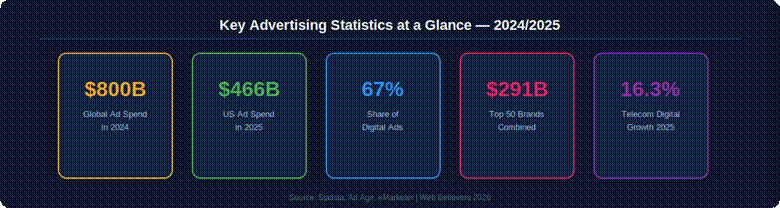
Key Advertising Spend Statistics at a Glance
Before diving into individual companies, here are the most important numbers:
- Global ad spending reached approximately $800 billion in 2024, up 8% year-over-year
- The United States accounts for the largest share — estimated at $466 billion in ad spend for 2025
- Digital advertising now represents over 67% of total ad spending in most regions
- The top 50 global advertisers increased their 2024 combined spending by 6.6% to $291 billion
- TV & Video Advertising remains the largest single category in the US at $158 billion in 2025
- Retail and Consumer Packaged Goods (CPG) are consistently the biggest spending industries
Quick Overview: Companies That Spend the Most on Advertising
The table below provides an at-a-glance summary of the world’s biggest advertising spenders, updated with the most recent available data:
| Company | Industry | Est. Annual Ad Spend | Key Markets |
| Amazon | E-commerce / Tech | $~20.6 billion | Global |
| Procter & Gamble | Consumer Goods | $~9.2 billion | US & Global |
| L’Oréal | Beauty / Cosmetics | €14.0 billion (~$15B) | Global |
| Samsung Electronics | Consumer Electronics | $~3.5 billion (US) | Global |
| Alphabet (Google) | Technology | $~7.0 billion | Global |
| Comcast Corporation | Media / Telecom | $~5.75 billion | US |
| AT&T | Telecommunications | $~3.5 billion | US |
| General Motors | Automotive | $~3.2 billion | US |
| Ford Motor Company | Automotive | $~2.5 billion | US |
| Verizon Communications | Telecommunications | $~2.6 billion | US |
| Unilever | Consumer Goods | $~7.8 billion | Global |
| LVMH | Luxury Goods | $~8+ billion | Global |
| Walmart | Retail | $~3.1 billion | US & Global |
| Meta (Facebook) | Technology / Social | $~3.0 billion | Global |
Note: Figures represent estimated total advertising spend across all media channels including TV, digital, print, outdoor, and radio. Sources: Company annual reports, Ad Age, Statista, and industry estimates.
Who Spends the Most on Advertising in 2026?
Below we explore the top 10 biggest US-focused advertising spenders in detail — their strategies, campaigns, and what sets them apart.
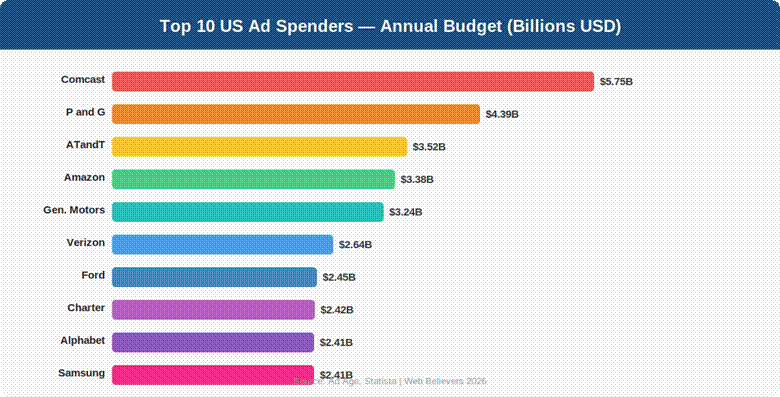
10. Samsung Electronics – $2.41 billion
Samsung is a globally recognized brand, producing smartphones, televisions, and a wide range of electronics. You may even be reading this on a Samsung device.
The company allocated $2.41 billion in the U.S. alone, much of it backing their #DoWhatYouCant campaign, created to promote the Galaxy S8.
Beyond the U.S., Samsung’s ads gained traction internationally as well, with one campaign in India ranking as one of YouTube’s most-watched ads. Their commercials also earned recognition for creativity, such as the award-winning “Ostrich” ad, where a bird learns to fly through a VR flight simulation.
Although Samsung is based in South Korea, it still secured a spot among the top ten advertisers in the U.S., placing just behind Alphabet.
Samsung’s Advertising Strategy
- Heavy investment in product launch campaigns — especially for Galaxy smartphones
- Mix of emotional storytelling with product feature showcases
- Strong presence on TV, YouTube, and digital platforms globally
- Sponsorship of major sporting events including the Olympics
9. Alphabet, Inc. – $2.41 billion
Not familiar with Alphabet? You’re not alone—many people aren’t.
Alphabet was created in 2015 after the restructuring of one of the world’s most recognized brands. Before the change, the company was simply known as Google—the same Google you likely use every day.
While most know Google as the largest ad platform globally, fewer realize the company itself spends billions on advertising across different media. A large portion of this budget went toward television commercials promoting Google Search, the Pixel smartphone, Google Play, and YouTube.
Alphabet also invests in advertising for its business tools, including Google Cloud and G Suite. Altogether, Alphabet ranks as one of only two internet-focused companies on this list.
What Makes Alphabet’s Strategy Unique
- Promotes within its own advertising ecosystem — a cost efficiency advantage
- Runs separate campaigns for consumer products (Pixel, Nest) and enterprise tools (Google Cloud)
- Relies heavily on brand storytelling to humanize technology products
- Uses owned channels (YouTube, Search) for launch campaigns before buying paid media
8. Charter Communications – $2.42 billion
Charter Communications operates under the Spectrum brand name.
As the second-largest cable provider after Comcast (who we’ll cover shortly), Charter grew further through acquisitions of Bright House Networks and Time Warner Cable.
Much of its ad spending went into promoting and rebranding Spectrum in regions already familiar with the acquired companies. Despite this significant investment, Charter still trails far behind industry giants AT&T and Comcast in advertising expenditures.
7. Ford Motor Company – $2.45 billion
Founded in 1903 by Henry Ford, this iconic automaker continues to invest heavily in advertising.In addition to its flagship Ford vehicles, the company also owns the luxury brand Lincoln. Both are promoted extensively across multiple channels, including television, print magazines, online banners, and other forms of media.
In 2017, Ford even tied into pop culture with a campaign connected to Guardians of the Galaxy, titled “Be the Guardian of Your Galaxy,” giving the brand a creative boost in visibility.
Ford’s Modern Ad Approach
- Big investment in EV (electric vehicle) campaigns as part of the industry transition
- Cross-platform campaigns spanning TV, streaming, social media, and outdoor
- Pop culture tie-ins and celebrity partnerships to boost visibility
6. Verizon Communications – $2.64 billion (How Much Does Verizon Spend on Advertising?)
Verizon, the telecom giant that many rely on for their mobile service, holds the sixth spot on the list.
Telecom companies appear frequently among the top advertisers, and while Verizon ranks sixth overall, it actually comes in third place for television ad spending.
Competing directly with other big players like AT&T and Sprint, Verizon dedicates billions to maintain its edge in such a fiercely competitive sector. However, 2017 wasn’t without challenges— the company experienced a major setback in customer confidence after a data exposure incident left six million users’ information vulnerable due to human error.
How Much Does Verizon Spend on Advertising?
Verizon spends approximately $2.6–3 billion annually on advertising and promotions, making it one of the largest telecom advertisers in the United States. The majority of this goes to television (national and local), digital platforms, and outdoor advertising.
5. General Motors – $3.24 billion
Jumping up nearly 20% from sixth place, General Motors holds the fifth spot as the largest advertiser in the U.S.
As the nation’s biggest automaker, GM spends the equivalent of about $10 per American on advertising. The company oversees several well-known brands, including Chevrolet, Cadillac, Buick, and GMC—each requiring its own campaigns running simultaneously.
One standout was the “Unbranded” commercial for the Chevy Malibu, which earned the first-ever Nielsen Automotive Tech Ad of the Year award. The clever ad removed the Chevrolet logo, leading viewers to believe the car belonged to a luxury brand, only to reveal the Chevy badge at the end.
4. Amazon – $3.38 billion
Alongside Alphabet, Amazon is the only other tech powerhouse to appear in the top ten spenders.
Its massive budget makes sense, especially considering the surge in advertising during the holiday season. Interestingly, while Amazon dominates this list, major competitors like Walmart, Costco, Kroger, and Target are nowhere to be found.
Though the website itself needs little promotion, Amazon still runs campaigns for its growing lineup of services and devices—such as Prime Video and the Echo. They also heavily advertise during high-traffic shopping events like Black Friday and Prime Day, ensuring their presence remains front and center with consumers.
Amazon’s Advertising Strategy Breakdown
- Full-funnel approach: awareness, intent capture, and conversion at point of purchase
- Heavy investment in seasonal events: Prime Day, Black Friday, and the holidays
- Promotes its Prime ecosystem heavily — video, music, fast delivery, and more
- Significant TV and streaming ad presence, including during NFL games
- Campaigns for Alexa, Echo, Ring, and Fire TV to drive device adoption
- Retail media platform: earns more from ads than many brands spend on advertising
3. AT&T – $3.52 billion
The telecom sector is one of the fiercest advertising battlegrounds, and AT&T is a prime example. The company invests billions in promoting its phone, internet, and cable services.
A significant portion of this budget goes toward television commercials, though AT&T also channels funds into print and digital campaigns. They don’t shy away from premium ad slots either—2017 saw the brand airing spots during the Master’s Tournament.
That same year, AT&T partnered with actor Mark Wahlberg in a series of commercials, a collaboration reportedly worth around $10 million.
2. Procter & Gamble – $4.39 billion
Marketers may instantly recognize Procter & Gamble, but the average consumer might not realize how many products fall under its umbrella.
P&G controls more than 60 well-known household and personal care brands, including Pampers, Tide, Charmin, Gillette, Febreze, Crest, and Dawn. This enormous portfolio explains why their ad budget dwarfs most competitors.
While the company invests across print, broadcast, and digital media, it reduced digital ad spending by $200 million in 2017 after research showed limited effectiveness. Instead, P&G redirected those funds to channels like television, radio, and eCommerce.
The company also holds significant sponsorships, such as with the International Olympic Committee. Among its 2017 campaigns, one of the most notable was “The Talk,” a socially charged ad addressing racial issues, which went viral and drew millions of views on YouTube.
P&G’s Multi-Brand Advertising Strategy
- Invests across print, broadcast, and digital media with discipline
- Strategically reduced digital spending by $200 million after finding limited ROI, then reinvested in TV, radio, and eCommerce
- Holds major sponsorships including with the International Olympic Committee
- Notable viral campaigns include “The Talk” (racial issues) and “Like a Girl” (Always brand)
- Uses brand-level advertising — each product (Tide, Pampers, etc.) has its own budget
1. Comcast Corporation – $5.75 billion
Topping the list by a wide margin, Comcast outspent its nearest competitor by about 30%. This dominance stems from the sheer scale of its holdings.
Comcast owns Xfinity, with many ads highlighting the advantages of its xFi service compared to traditional WiFi. Beyond that, Comcast’s portfolio includes major media outlets like NBC, Telemundo, USA Network, and E! Entertainment.
The company also operates Universal Pictures, backing blockbuster films released in 2017 such as Get Out, The Fate of the Furious, The Mummy, Despicable Me 3, and Pitch Perfect 3.
Additionally, Comcast promotes its Universal theme parks and resorts, particularly the attractions in Orlando, Florida. With its vast range of brands, Comcast’s massive advertising budget is spread across multiple industries, from entertainment to telecommunications.
Conclusion
It’s unlikely that your business operates on the same scale as the corporations behind these billion-dollar advertising budgets. Still, there are valuable lessons to take away from how these companies allocate their spending.
Their approach to advertising reveals not only how they view their products but also the level of commitment they place on attracting and retaining customers.
By examining these strategies, you can uncover insights to refine your own marketing efforts and make smarter decisions about where and how to invest your budget.
Top Companies That Spend the Most on Advertising — Global Perspective
While the above list focuses on US spending, the global picture is even more impressive. When looking at total worldwide advertising investment, a slightly different set of companies emerges at the top:
1. Amazon – ~$20+ Billion Globally
Amazon tops the global rankings for the third consecutive year. Its advertising covers e-commerce, Prime Video, AWS Cloud services, Alexa devices, and emerging markets. Amazon’s ad strategy emphasizes customer acquisition at scale and reinforces its Prime ecosystem across every touchpoint.
2. L’Oréal – ~$15 Billion (€14 Billion) Globally
L’Oréal is the world’s largest cosmetics company and the top beauty advertiser globally. The company discloses its advertising and promotional expenses directly — reporting €14,009 million in its latest registration document. Over 60% of its digital ad spend now goes to social media platforms, leveraging creator content for discovery while maintaining strong brand identity across all channels.
3. Procter & Gamble – ~$9.2 Billion Globally
P&G remains one of the most consistent global advertisers. Its portfolio of 65+ brands requires continuous multi-channel investment across every major market. P&G is considered a gold standard for multi-brand advertising management.
4. Unilever – ~$7.8 Billion Globally
Unilever manages a portfolio of over 400 brands including Dove, Axe, Hellmann’s, and Ben & Jerry’s. Its advertising strategy focuses on purpose-driven marketing, which has helped increase brand relevance and consumer loyalty globally.
5. LVMH – $8+ Billion Globally
LVMH (Louis Vuitton Moët Hennessy) is the biggest advertising spender in the luxury sector. The company’s strategy focuses on cultural dominance and controlled desirability rather than broad reach — investing in high-impact moments, editorial content, and immersive brand experiences to protect pricing power and margin.
Which Industries Spend the Most on Advertising?
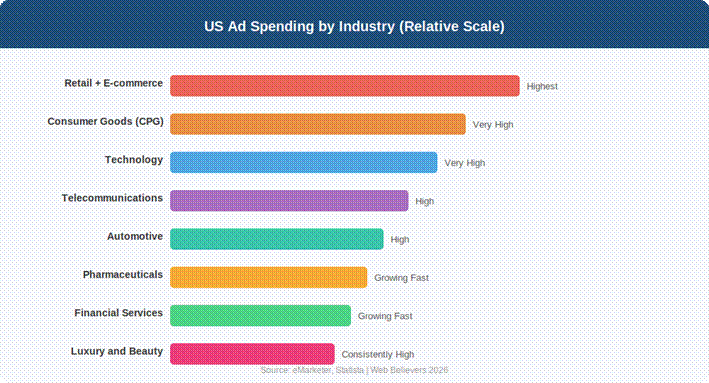
Understanding advertising by industry helps put individual company budgets in context. Here is how the major sectors compare:
| Industry | Spending Level | Top Channels |
| Retail & E-commerce | Highest overall ($50B+ combined) | Digital, TV, Outdoor |
| Consumer Packaged Goods | Very High ($30B+ combined) | TV, Digital, Print |
| Telecommunications | High ($15B+ combined) | TV, Digital, OOH |
| Automotive | High ($14B+ combined) | TV, Digital, Print |
| Pharmaceuticals / Healthcare | Growing rapidly | TV, Digital |
| Financial Services | Strong growth in 2024–25 | Digital, TV |
| Technology & Software | Surging ($20B+ combined) | Digital, Social, TV |
| Luxury / Beauty | Consistently high | Social, Digital, Print |
Retail & E-Commerce (Biggest Spending Industry)
Retail and e-commerce brands — led by Amazon and Walmart — represent the single largest advertising category in the United States. Retail media is growing rapidly, with brands like Amazon, Walmart, and Target building their own advertising networks.
Consumer Packaged Goods (CPG)
Companies like P&G and Unilever spend billions promoting everyday household products. Since many CPG products are low-involvement purchases, advertising is critical to maintaining mental availability and shelf presence.
Telecommunications
Telecom is among the most competitive advertising industries. AT&T, Verizon, T-Mobile, and Comcast all spend billions competing for subscribers. In 2024–2025, telecom led all industries in digital ad spending growth at over 16%.
Pharmaceutical & Healthcare
Pharmaceutical advertising has grown dramatically. In any given week, the top TV ad spenders often include drug brands like Skyrizi, Zepbound, Caplyta, Tremfya, and Rinvoq — each spending millions per week in national TV airings alone.
Insurance
Insurance brands like Progressive, Allstate, and Liberty Mutual consistently rank among the top weekly TV spenders. Progressive alone spent over $10 million on national TV advertising in a single week (May 2026).
Top TV Advertising Spenders (Current Week — May 2026)
TV advertising remains a critical channel for the biggest brands. According to iSpot.tv data, the top national TV ad spenders in a recent week include:
- Progressive Insurance — $10.4 million (6,507 national airings)
- Amazon — $5.3 million (2,234 national airings)
- SKYRIZI (Crohn’s/UC) — $5.3 million (1,680 national airings)
- Zepbound (weight loss drug) — $4.9 million (638 national airings)
- CAPLYTA (antidepressant) — $4.8 million (3,280 national airings)
- Allstate Insurance — $3.8 million (1,386 national airings)
- CarShield — $3.5 million (3,976 national airings)
- Liberty Mutual — $3.2 million (1,820 national airings)
This weekly data reveals how pharmaceutical, insurance, and e-commerce brands dominate TV advertising in the modern landscape — a significant shift from the automotive and telecom dominance of the early 2000s.
How Do the Biggest Ad Spenders Allocate Their Budgets?
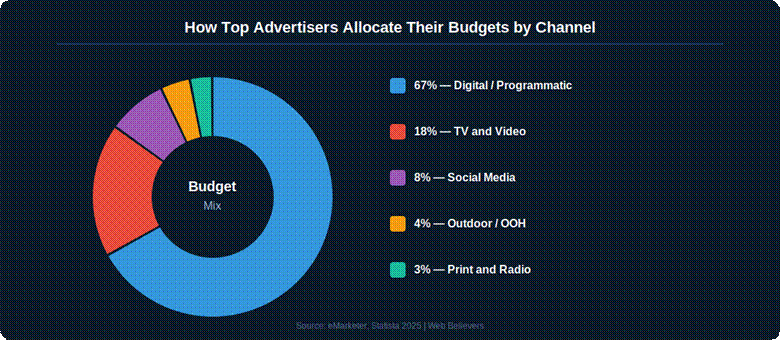
Understanding how top advertisers split their budgets across channels provides strategic insights for any business. Here’s how the biggest spenders typically allocate their advertising dollars:
Television (National & Local)
Despite predictions of its decline, TV advertising remains massive. It is particularly dominant for CPG, pharmaceutical, telecom, and insurance brands. National TV advertising during premium events (Super Bowl, NFL, Olympics) commands the highest CPMs but delivers unmatched reach.
Digital & Programmatic
Digital advertising (search, display, social, programmatic) now accounts for over 67% of total ad spend in most regions. The biggest spenders use programmatic buying to reach specific audiences at scale, with AI-driven targeting improving ROI continuously.
Social Media
Social platforms — Facebook/Instagram (Meta), YouTube, TikTok, Snapchat — have become essential channels. Beauty brands like L’Oréal put over 60% of their digital budget into social. Influencer and creator content is increasingly part of big-brand strategies.
Streaming & Connected TV (CTV)
Connected TV (CTV) is the fastest-growing advertising channel. Brands are following audiences to streaming platforms, with Amazon Prime Video, Netflix (with ads), Hulu, and Peacock all attracting major advertising dollars.
Out-of-Home (OOH) & Outdoor
Billboards, transit advertising, and digital signage remain part of major ad mixes — particularly for brands wanting to reinforce awareness in urban markets and at major events.
Retail Media Networks
One of the fastest-growing trends: Amazon Advertising, Walmart Connect, Target Roundel, and similar platforms allow brands to advertise directly at the point of purchase. This has become a multi-billion dollar channel.
Why Do Some Companies Spend So Much More Than Others?
Not all big companies are big advertisers. Apple, for example, is the world’s most valuable brand but spends far less on advertising (under $2 billion) compared to companies like P&G or L’Oréal. What drives extreme advertising investment?
1. Portfolio Size
Companies like P&G and Unilever manage dozens or hundreds of individual brands, each requiring its own advertising. A single company managing 60+ brands naturally spends 60x more than a single-product company.
2. Competitive Category
Industries like telecom, insurance, and fast food are brutally competitive. Every percentage point of market share is worth billions, so companies spend aggressively to defend and grow their position.
3. Low Product Differentiation
CPG products like detergent, toothpaste, or shampoo are largely similar in function. Advertising creates perceived differentiation and brand loyalty in categories where the product itself doesn’t stand out.
4. High Customer Lifetime Value
For subscription businesses (telecoms, streaming services) and loyalty programs (Amazon Prime), acquiring a customer is extremely valuable long-term. This justifies high upfront ad spending.
5. Event-Driven Revenue
Companies like Amazon drive disproportionate revenue during short windows (Prime Day, Black Friday, holidays). Heavy pre-event advertising is a core strategy to maximize these opportunities.
What Can Small Businesses Learn from the Biggest Ad Spenders?
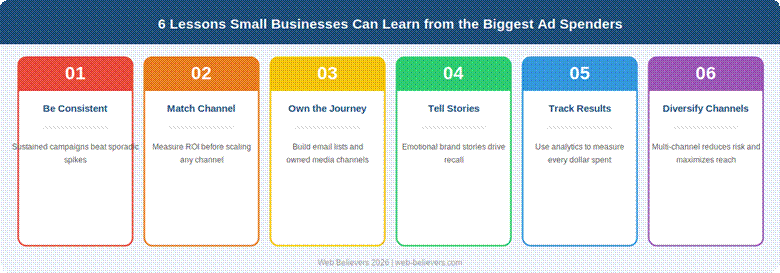
It’s unlikely that your business operates on the same scale as the corporations behind these billion-dollar advertising budgets. Still, there are valuable lessons to take away from how these companies allocate their spending.
Lesson 1: Consistency Beats Spikes
The biggest advertisers don’t just run campaigns — they maintain consistent brand presence year-round. Rather than blowing your budget on one big campaign, consider sustained investment across your most effective channels.
Lesson 2: Match Channel to Audience
P&G famously reallocated $200 million away from digital back to TV after measuring poor digital ROI. The lesson: don’t follow trends blindly. Measure, test, and invest in what actually works for your specific audience.
Lesson 3: Own Your Customer Journey
Amazon’s advertising advantage comes from owning the entire funnel — from discovery to purchase to retention. Build owned channels (email lists, loyalty programs, content) alongside paid advertising.
Lesson 4: Emotional Storytelling Works
Some of the most memorable campaigns from these giants (P&G’s ‘The Talk’, Apple’s ‘Shot on iPhone’, Dove’s ‘Real Beauty’) succeed through emotional connection rather than product promotion. Brand story matters.
Lesson 5: Track Performance Relentlessly
Every major advertiser uses advanced analytics to measure the return on each dollar spent. Even with a small budget, use available tools (Google Analytics, Meta Ads Manager, etc.) to track what’s working.
Lesson 6: Diversify Across Channels
No major brand relies on a single channel. A diversified approach — combining search, social, content, and even traditional media — reduces risk and maximizes reach across different audience segments.
So, after looking at the ad spends of these major players, what lessons can you apply to your own advertising strategy?
Frequently Asked Questions
Q1. Why do large companies spend so much on advertising?
Big corporations invest heavily in advertising to maintain visibility, build brand recognition, reach new customers, and stay competitive in crowded markets.
Q2. Which industry spends the most on advertising in the U.S.?
Telecommunications and consumer goods companies are among the top spenders, with tech and automotive brands also investing billions annually.
Q3. Do smaller businesses need to spend like these giants to succeed?
No. While large companies spend billions, smaller businesses can achieve success with a well-targeted strategy, focusing on cost-effective channels such as digital marketing and social media.
Q4. How do these ad budgets impact consumers?
High ad spending often leads to greater brand awareness and exposure, shaping consumer perceptions and influencing purchasing decisions.
Q5. Why are some big retailers like Walmart or Target not on the list?
While they invest in marketing, their budgets are smaller compared to companies like Amazon, Comcast, or P&G, which spread advertising across multiple products, services, or media platforms.
Q6. What lessons can small businesses learn from these advertising giants?
Small businesses can learn to diversify their ad spend, track performance, and focus on building strong brand identity, even on a modest budget.