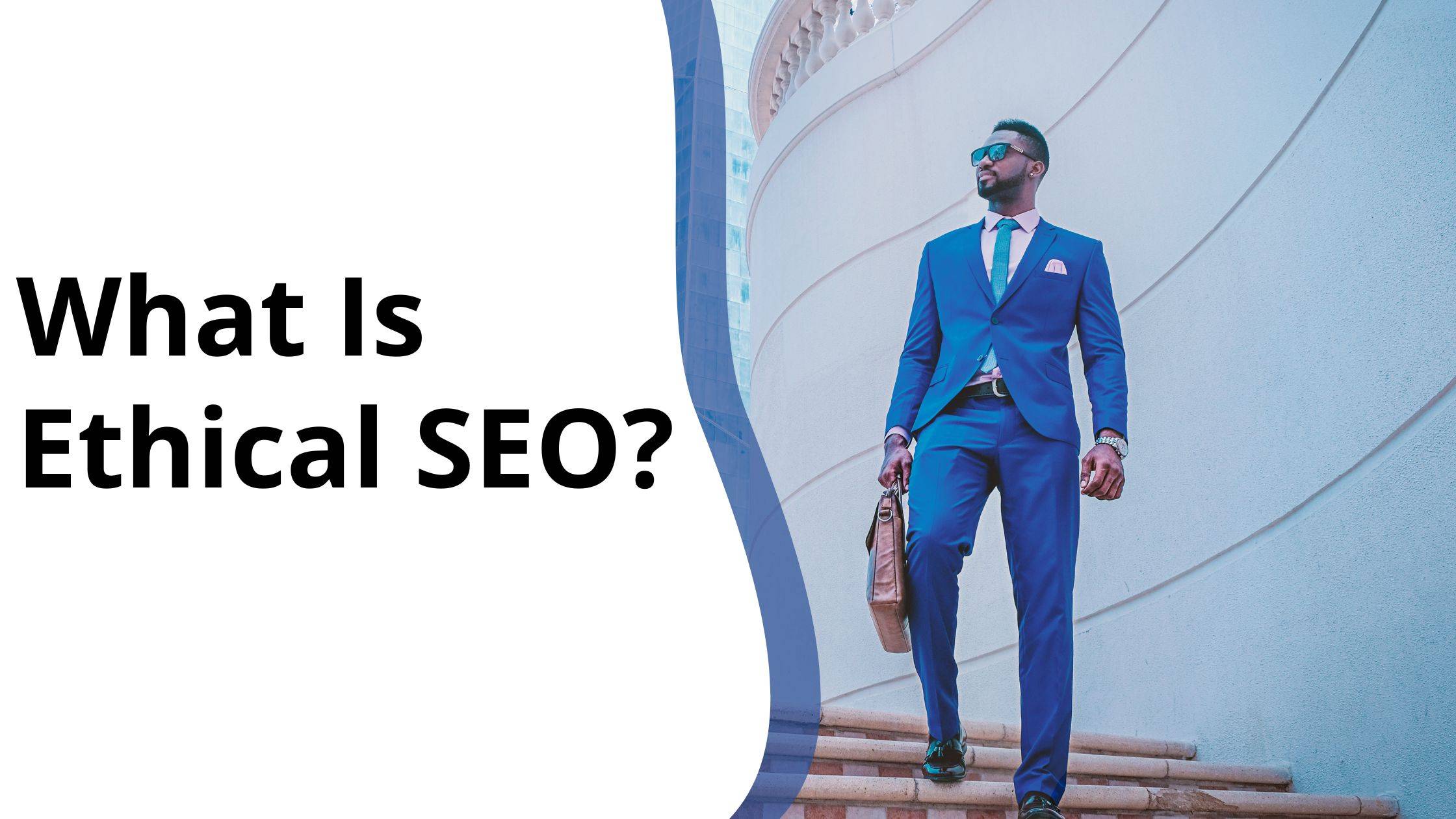
The conversation around ethics in SEO, digital marketing, and technology is more important than ever. People naturally gravitate toward ethical concepts—whether it’s ethically sourced products or ethically raised food—because ethics provide a framework for understanding the consequences of our actions.
Whether intentionally or not, humans engage with moral philosophy. We make choices based on what we believe to be right or wrong, and those beliefs shape both our personal lives and society as a whole.
In SEO, ethics are defined by whether a search engine considers a technique or strategy acceptable. However, this definition is not universal—it’s determined by the companies that design the search engines themselves.
This means:
- Ethics apply only to techniques and strategies.
- They vary depending on the search engine.
- What’s ethical for one platform may be unethical for another.
Search engines aren’t moral entities, nor are websites. Instead, they reflect the choices of the people who build and use them. The code inherits human decisions, biases, and blind spots.
Every digital asset embodies the ethics of the business behind it, the individuals writing the code, and the behaviors of its users. This ethical layer influences whether an action is seen as optimization or manipulation.
For example, structured data markup can serve as a “cheat sheet” for search engines. Some may approve of this practice, while others may not. Ultimately, ethical SEO depends on the standards set by the search engine and the intent of those implementing the strategy.
Creating a Human-Centric Definition of Ethics in SEO
Ethical questions rarely have clear-cut right or wrong answers. Instead, they serve as thought experiments—placing situations against a moral framework for evaluation.
There are countless ethical theories and principles, but for simplicity, consider the philosophy of Immanuel Kant. He reduced the ethical value of actions to two guiding questions:
- Can I reasonably wish that everyone would act as I intend to act?
- Does my action respect the goals of human beings rather than using them solely for my own purposes?
If either question is answered with “no,” then the action is deemed unethical.
Code, by itself, cannot decide whether displaying a controversial app—such as one that allowed Saudi men to control the movement of dependent women—is ethical. Is that an example of digital-age misogyny or simply cultural relativism? These debates lead to complex discussions around human rights and technology that extend beyond this space.
Taking a broader perspective, if SEO defines morality relative to platform guidelines, then this app would be considered “ethical” according to the Google Play Store’s rules.
But through Kant’s lens, could we genuinely will that others act only in ways that prioritize guidelines benefiting themselves?
A striking example came in early 2019, when TurboTax, a major U.S. tax service, blocked search engines from indexing a page that would have allowed low-income users to file federal taxes for free.
In business terms, TurboTax identified a low-return audience—people earning $34,000 or less, or active-duty military members earning $66,000 or less. Instead of serving this group directly, the company leaned on its strong brand reputation and cross-platform marketing to push users toward paid products.
The real-world outcome resembled a bait-and-switch. A search for free federal tax filing led users to a “Free Edition” landing page—different from the IRS-backed Free File Program. Despite its bold promises, this version charged between $60–$120.
ProPublica tested this repeatedly by creating different user profiles. In every case, the mock filer was funneled into the same dead end: paying for an upgrade before completing their return.
This strategy disproportionately impacted low-income earners and military personnel. Lawmakers even raised concerns with the FTC and IRS. The technique of using design and conversion pathways to push people into actions they didn’t intend is known as dark patterning.
As part of this approach, TurboTax used organic search strategically—adding robots noindex tags to hide the actual free product. The result? Only 3% of users accessed the genuine free service, even though 70% qualified.
Here’s where Kant’s framework comes back into play:
- Can I rationally will that everyone act as I propose to act?
- Does my action respect human goals rather than exploiting them?
Search Engines as Imprints of Power
Websites and search engines carry the ethics, biases, and norms of those who build and control them. When successful, they become artifacts of power—or more lightly put, symbols of brand dominance. The longer that influence lasts, the more it shapes culture and technology.
Language plays a major role in scaling this power.
In 2019, English represented 54% of online content while only 25% of users spoke it. Russian followed at just 5.9%. The imbalance is so vast it could warrant its own guided tour. And the consequences are significant.
Language shapes reality. The words we have define the concepts we can recognize. When something new emerges, we give it a name.
Take the example of page view, which was only recently added to Merriam-Webster. The absence of a dictionary definition never stopped SEOs from using it—the digital community had already validated and spread it. Language evolves as we adopt new terms.
But not every community adapts as quickly. When concepts aren’t available in a given language, entire groups risk being excluded from engaging with or adopting them.
This is especially dangerous in fast-moving fields like medicine and technology.
One study of an HIV prevention program funded by U.S. companies revealed that over 80% of participants didn’t understand essential concepts such as placebo, randomization, or withdrawal rights.
Can it be ethical to enroll someone in a clinical trial if they don’t understand what a placebo is?
Meanwhile, the recruitment page for these studies was indexed by Google, optimized for performance, and ranked well. Yet, at the time of review, it was only available in English—limiting accessibility for many potential participants.
Translations, Cookies, & Communities
Consider something as seemingly small as a cookie policy.
Do users fully grasp what they’re agreeing to when they accept? Do they understand that their data may be tracked, used for remarketing, or that content recommendations will be shaped by their behavior? Do they realize the platform may also determine the boundaries of what qualifies as free speech?
If your site relies on user-generated content, how do you address hate speech in a language that no one on your team speaks?
The lack of oversight in translation and moderation has already shown devastating consequences. Facebook’s failure in this area contributed directly to the Rohingya refugee crisis, where more than 70,000 people were forced to flee their homes. In this context, unchecked platform growth without adequate translation or regulation has arguably had more severe societal impact than the cost of investing in a translation budget.
A study by Translators Without Borders during the European Refugee Crisis illustrates the same issue. Humanitarian events rarely provide the luxury of preparation. When thousands of asylum seekers arrive in need, aid teams often must adapt quickly with limited resources.
The most powerful tool in such situations is communication. Yet not all displaced people speak the same language. For example, in just six months, 14,000 Nigerian refugees arrived in Italy—Nigeria itself has over 520 languages. Knowing which languages were most represented could have helped humanitarian teams deploy the right translators and resources more effectively.
Without clear, objective information in their own language, many refugees were forced to rely on hearsay or social media posts for critical updates. Some had internet access, but without accessible translations, they turned to Facebook memes for life-saving guidance.
This raises an important ethical point: involving native speakers in content creation and community moderation may be a responsibility, not an option, when operating globally. The consequences of neglecting this can be profound. Sometimes, the most ethical act could be as simple as pulling an overlooked translation ticket from the backlog and prioritizing it in the next sprint.
Paying for Rank by Mortgaging Trust
Search has become so ubiquitous that we barely notice its presence anymore.
Back in 2012, Google reported handling over 40,000 search queries every second. That figure hasn’t been updated publicly since, but today it’s undoubtedly higher. If each query were a snowflake, we’d be buried under a blizzard of information—one we rarely stop to acknowledge.
Users trust search engines because they appear to know the answers. They have the reach to scan the web and the authority to sort, prioritize, and present results.
SEO professionals sit at the crossroads of this system. By refining page titles, cleaning up code, and optimizing experiences, we influence which answers appear, where they show, and to whom. In many ways, we’re weaving ourselves into the very fabric of global knowledge.
That’s both exciting—and daunting. Because it also places us on the front lines of maintaining user trust.
Freedom of Speech vs. Misinformation
Consider the 2020 U.S. presidential election.
A user searching for [Joe Biden 2020] would naturally expect to find the candidate’s official website. Yet, a parody site—built by a consultant working on Donald Trump’s campaign—appeared just below the real one in Google’s results. This site wasn’t poorly executed either: it scored a flawless 100 on web.dev performance and a 93 in accessibility.
In 2016, Facebook bore the brunt of “fake news” criticism. But search engines are not immune. Ranking alongside a competitor for their branded queries is often hailed as a win in SEO circles. But when political parody and misinformation blend seamlessly into SERPs, the ethical lines blur.
Even more concerning, misinformation is not always about false facts—it’s about trust. When influential figures accuse search engines of bias, collusion, or political interference, public perception shifts. Credibility fractures. And once users stop trusting results, even the most sophisticated algorithms cannot contain the fallout.
The Myth of the “Unbiased” Algorithm
Algorithms are not neutral. They are shaped by the biases of their creators and datasets. When paired with machine learning that adapts to human interaction, these blind spots can spiral.
Take Microsoft’s infamous Twitter bot, which descended into racist tirades in less than 24 hours. Or facial recognition software in the U.K., criticized for disproportionately misidentifying non-white subjects due to flawed datasets.
The lesson is simple: representation matters. Teams building these tools must reflect diverse languages, ethnicities, and gender identities. Otherwise, entire groups risk being excluded—or worse, misrepresented—in future systems.
In ethics, “works on my machine” is not enough. What doesn’t fail for you could fail catastrophically for someone else.
Transparency and Personalization
Search personalization further complicates ethics. Algorithms bucket us into personas—A or B—and show us results tailored to our behavior. But this also creates echo chambers. When users only see results they already agree with, their worldview narrows.
Transparency around personalization isn’t just a nice-to-have; it’s essential. Users deserve to understand how their results are shaped and what perspectives may be missing.
Toward a Human-Centric Definition of Ethics in SEO
So, what does “ethical SEO” look like? There’s no single answer—only better questions.
Frameworks like Kant’s remind us to ask:
- Can I rationally will that everyone acts as I propose to act?
- Does my action respect the goals of human beings, rather than using them for my own purposes?
As SEO professionals, we must weigh these questions every time we optimize content, build campaigns, or influence visibility.
Ethical SEO isn’t about perfection—it’s about awareness. It’s about pausing to consider when human rights and values should override technical guidelines.
There will never be a final answer. But by asking better questions, we ensure our work strengthens—not mortgages—user trust.
FAQs: What Is Ethical SEO?
1. What does Ethical SEO mean?
Ethical SEO refers to search engine optimization practices that follow search engine guidelines, prioritize user experience, and avoid manipulative or deceptive tactics. It focuses on transparency, honesty, and long-term trust-building.
2. How is Ethical SEO different from Black Hat SEO?
Black Hat SEO uses manipulative tactics like keyword stuffing, link schemes, and cloaking to gain quick rankings, often violating search engine rules. Ethical SEO, on the other hand, aligns with guidelines and aims for sustainable growth through quality content and user-focused strategies.
3. Why is Ethical SEO important for businesses?
It protects a brand’s reputation, builds user trust, ensures compliance with search engine policies, and helps achieve long-term visibility without the risk of penalties.
4. What are examples of Ethical SEO practices?
Examples include publishing original content, improving website accessibility, optimizing site speed, using relevant keywords naturally, building genuine backlinks, and being transparent with users about data usage.
5. Can Ethical SEO still achieve top rankings?
Yes. While it may take longer than shortcuts, Ethical SEO creates lasting results by combining quality content, technical optimization, and a positive user experience—factors search engines reward over time.
6. Does Ethical SEO include accessibility and inclusivity?
Absolutely. Making websites accessible to users of different languages, abilities, and devices is part of Ethical SEO, as it respects all users and improves overall experience.
7. How can I check if my SEO agency follows ethical practices?
Ask about their strategies. If they promise instant rankings, use private link networks, or avoid explaining their methods, it’s a red flag. Ethical SEO agencies are transparent, guideline-compliant, and focused on long-term growth.